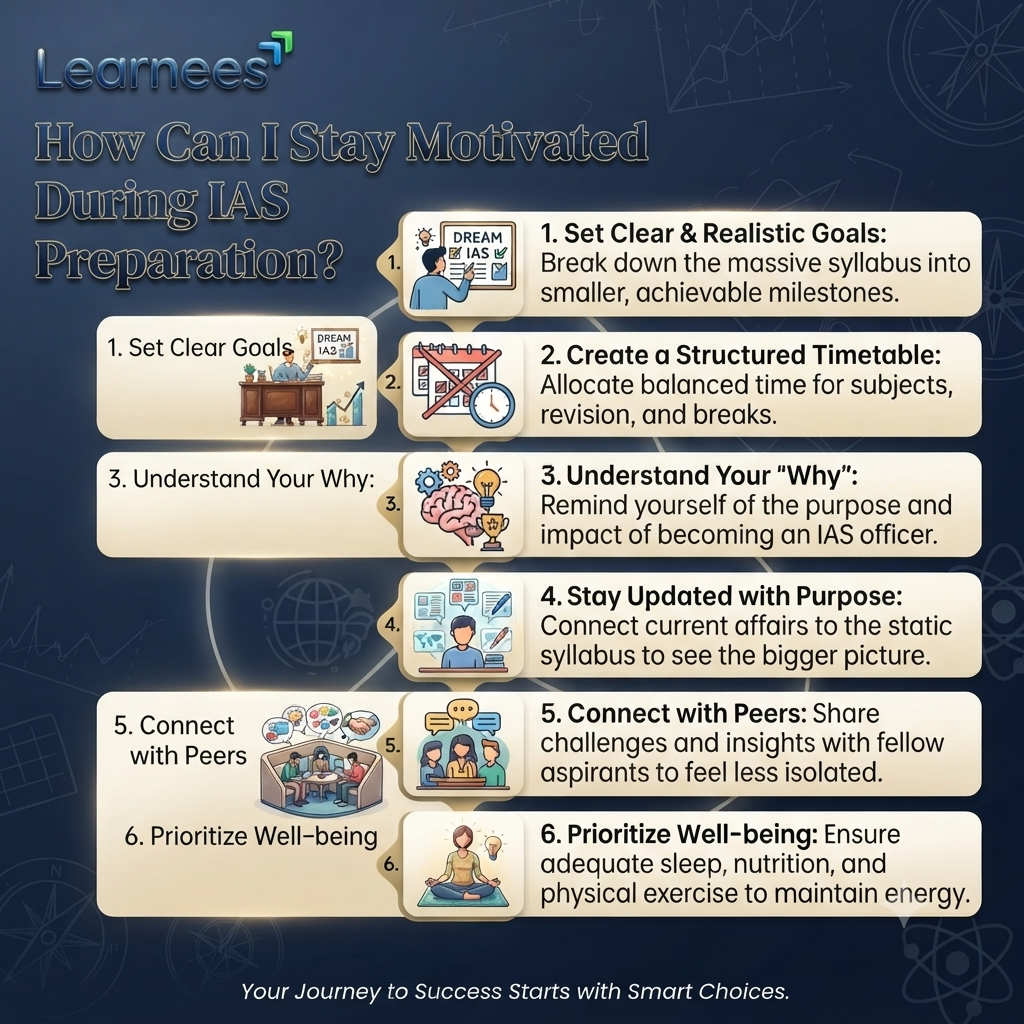
Preparing for the IAS exam through UPSC Civil Services Examination (CSE) is a long-term journey. The syllabus is extensive, competition is high, and preparation can take months or even years. During this period, it is normal for aspirants to experience days when they feel highly motivated as well as days when studying feels difficult. The key is not to stay motivated every single day. Instead, successful preparation requires developing consistent study habits, realistic goals, and ways to recover when motivation drops.
Table of Contents
- Understand Your Reason for Preparing
- Set Small and Achievable Goals
- Create a Realistic Study Routine
- Focus on Consistency Instead of Long Hours
- Track Your Progress
- Avoid Comparing Yourself With Other Aspirants
- Take Regular Breaks
- Use Mock Tests to Measure Improvement
- Learn From Mistakes Instead of Dwelling on Them
- Keep Your Study Resources Limited
- Stay Connected With Supportive People
- Manage Social Media and Distractions
- Take Care of Your Sleep and Health
- Accept Difficult Days
- Keep Your Long-Term Goal in Mind
- FAQs
1. Understand Your Reason for Preparing
Before creating a timetable, ask yourself why you want to prepare for the IAS exam.
Your reason could be a desire to work in public administration, contribute to society, pursue a challenging career, or achieve a personal goal.
Knowing your reason can help you stay focused when preparation becomes difficult.
Write your reason somewhere you can see it regularly. However, remember that motivation based only on emotion can fluctuate. Your daily routine and habits should support your goal as well.
2. Set Small and Achievable Goals
The UPSC syllabus can look overwhelming when viewed as one huge task.
Instead of thinking:
“I have to complete the entire UPSC syllabus.”
Break it into smaller targets such as:
- Complete one chapter of Polity.
- Revise 20 pages of notes.
- Solve 30 MCQs.
- Read and analyse one current-affairs topic.
- Complete one previous-year question set.
- Write one answer for Mains practice.
Small goals make progress easier to see and can reduce the feeling of being overwhelmed.
Try the Daily 3-Task Method
At the beginning of each day, identify three important academic tasks.
For example:
| Priority | Task | Approx. Time |
| 1 | Polity chapter | 2 hours |
| 2 | Current affairs | 1 hour |
| 3 | Answer writing | 1 hour |
Once these are completed, you can move on to additional tasks if you have time and energy.
3. Create a Realistic Study Routine
A timetable should fit your actual lifestyle rather than an idealized routine.
Some aspirants may be able to study for several hours every day, while others may have college, work, or family responsibilities.
Create a schedule that you can realistically follow.
A simple routine could include:
Morning: Core subject study
Afternoon: Current affairs and revision
Evening: MCQs or answer writing
Night: Short revision and next-day planning
The exact timing is less important than having a routine that you can maintain consistently.
4. Focus on Consistency Instead of Long Hours
Studying for 12–14 hours one day and then struggling to study the next day is not necessarily an effective strategy.
Instead, aim for sustainable study sessions.
For example, you might divide your day into focused blocks:
- 90 minutes of focused study
- Short break
- 90 minutes of focused study
- Longer break
- Another focused session
- Revision or practice
Your concentration may vary throughout the day, so experiment with different study periods and identify when you work best.
Consistency over time is more useful than simply counting study hours.
5. Track Your Progress
Motivation can decrease when you feel that you are not making progress.
A simple progress tracker can help.
You can track:
- Subjects completed
- Chapters revised
- Mock tests attempted
- MCQs solved
- Mains answers written
- Previous-year questions analysed
- Revision cycles completed
For example:
| Week | Subject | Study Progress | Practice |
| Week 1 | Polity | 4 chapters | 150 MCQs |
| Week 2 | Geography | 3 chapters | 120 MCQs |
| Week 3 | Economy | 4 chapters | 150 MCQs |
Looking back after several weeks can remind you that even small daily efforts add up.
6. Avoid Comparing Yourself With Other Aspirants
One of the biggest motivation killers during UPSC preparation is constant comparison.
You may see someone claiming to study 12 hours a day, finish multiple books, or complete the syllabus much earlier than you.
Remember that every aspirant has a different:
- Educational background
- Study speed
- Schedule
- Learning style
- Level of preparation
- Revision strategy
Instead of asking, “Am I ahead of them?”, ask:
“Am I making progress compared with where I was last month?”
Your own progress is a more useful reference point.
7. Take Regular Breaks
Breaks are not necessarily a waste of study time.
Long periods of continuous studying can make concentration difficult. Short breaks can help you return to your books with better attention.
During a break, you could:
- Walk around
- Stretch
- Drink water
- Talk briefly with family
- Rest your eyes
- Have a healthy meal or snack
Try to keep breaks intentional so that a short break does not turn into an hour of scrolling.
8. Use Mock Tests to Measure Improvement
Mock tests can make preparation more interactive and provide measurable feedback.
Instead of studying only through reading, regularly practice:
- Prelims MCQs
- Previous-year questions
- Mains answer writing
- Full-length mock tests
- Topic-wise tests
After each test, spend time analysing your mistakes.
Ask:
- Why did I get the question wrong?
- Was it a knowledge gap?
- Did I misunderstand the question?
- Did I make a calculation or factual mistake?
- Did I manage my time poorly?
The purpose of a test is not simply to obtain a score. It is also to identify areas that need improvement.
9. Learn From Mistakes Instead of Dwelling on Them
A low mock-test score can be discouraging, but one test does not determine your final result.
Treat mistakes as information.
For example, if you repeatedly make mistakes in a particular topic, add that topic to your revision list.
You can maintain a mistake notebook containing:
- Incorrect questions
- Important concepts
- Frequently confused facts
- Weak topics
- Revision points
Review this notebook regularly.
Over time, mistakes can become a useful part of your learning process.
10. Keep Your Study Resources Limited
Another common problem is collecting too many resources.
You may start with one book, then find another book, several PDFs, multiple YouTube videos, Telegram channels, websites, and different sets of notes.
This can create confusion and make you feel that your preparation is never complete.
Before adding a new resource, ask:
“Does this resource fill a genuine gap in my current preparation?”
Choose resources carefully and give enough time to revision and practice.
11. Stay Connected With Supportive People
UPSC preparation can sometimes feel isolated.
Talking to supportive family members, friends, teachers, mentors, or fellow aspirants can help you maintain perspective.
You do not have to discuss preparation all the time. Sometimes simply taking a break and having a normal conversation can help you return to your studies with a clearer mind.
If you are part of an aspirant community, focus on constructive discussions rather than constant comparison of study hours, test scores, or resources.
12. Manage Social Media and Distractions
Social media can make it difficult to maintain concentration.
You do not necessarily need to eliminate every form of entertainment. Instead, create boundaries.
For example:
- Keep your phone away during study sessions.
- Turn off unnecessary notifications.
- Use website or app limits if needed.
- Avoid checking social media after every study session.
- Set specific times for entertainment.
A simple rule can help:
Study first, entertainment later.
This makes leisure time more intentional instead of allowing it to interrupt your preparation repeatedly.
13. Take Care of Your Sleep and Health
Preparation is a long-term process, so your daily routine should include adequate rest.
Try to maintain regular:
- Sleep
- Meals
- Physical activity
- Hydration
- Breaks
Sacrificing sleep repeatedly to increase study hours can make it harder to concentrate and retain information.
Your preparation should be sustainable enough to continue for the long term.
14. Accept That Motivation Will Not Always Be High
This is one of the most important lessons for any serious aspirant.
You will probably have days when you do not feel like studying.
That does not automatically mean you should abandon your plan.
On difficult days, reduce the target instead of completely stopping.
For example, if you planned to study three chapters but feel exhausted, you might revise one chapter and solve a small set of questions.
The goal is to maintain continuity while allowing yourself to recover.
You do not need to feel motivated before every study session. Sometimes starting the session is what creates momentum.
15. Keep Your Long-Term Goal in Mind
UPSC preparation can become repetitive.
Reading, revising, practising questions, analysing mistakes, and repeating the process may not always feel exciting.
This is where your long-term purpose matters.
Keep a simple reminder of:
- Why you started
- What you want to achieve
- What you have already accomplished
- What remains to be completed
At the same time, avoid making your entire life revolve around one exam. Maintaining healthy routines, relationships, interests, and rest can make the preparation journey more sustainable.
A Simple Motivation Plan for IAS Aspirants
If you are struggling with motivation, try this simple seven-day reset:
| Day | Focus |
| Day 1 | Review your current preparation |
| Day 2 | Set three realistic daily goals |
| Day 3 | Complete one focused study block |
| Day 4 | Attempt a small practice test |
| Day 5 | Analyse your mistakes |
| Day 6 | Revise previously studied topics |
| Day 7 | Review the week’s progress and plan the next week |
The purpose is not to create a perfect week. It is to rebuild consistency.
How Learnees Can Help You Explore IAS Preparation Options
Finding the right learning resources, courses, or preparation options can take time. Learnees is an education marketplace where students and parents can explore educational institutes, courses, and learning options in one place.
Instead of choosing an option only because it is popular, compare factors such as:
- Course structure
- Subjects covered
- Learning format
- Faculty information
- Test and assessment options
- Fees
- Location or online accessibility
- Reviews and available course details
This can help you make a more informed choice based on your own preparation needs.
Frequently Asked Questions
1. How do I stay motivated for IAS preparation?
Set realistic daily goals, maintain a consistent routine, track your progress, practise regularly, and remind yourself why you started. Motivation may fluctuate, so building consistent habits is equally important.
2. What should I do when I lose motivation during UPSC preparation?
Reduce your workload temporarily, complete a small achievable task, take a proper break, and review your progress. Starting with a small task can make it easier to regain momentum.
3. Is studying for long hours necessary for IAS preparation?
There is no single number of study hours that guarantees success. The quality, consistency, understanding, revision, and practice of your preparation are important factors.
4. How can I avoid comparing myself with other UPSC aspirants?
Focus on your own preparation metrics, such as completed topics, revision cycles, practice questions, and test performance. Other aspirants may have very different backgrounds and schedules.
5. Can mock tests help with motivation?
Yes. Regular tests can provide measurable feedback about your preparation. Analysing mistakes can also help you identify specific areas for improvement.
6. How can I stay consistent with my IAS study schedule?
Keep your timetable realistic, divide large tasks into smaller goals, reduce distractions, track your progress, and allow adequate rest.
7. What if I have a bad study day?
Do not treat one unproductive day as a complete failure. Identify what caused the problem, complete a smaller task if possible, and return to your normal routine the following day.
Conclusion
Staying motivated during IAS preparation is less about feeling enthusiastic every day and more about building a system that helps you continue even when motivation is low.
Set realistic goals, study consistently, practise questions, analyse your mistakes, take care of your health, and avoid unnecessary comparison with other aspirants. Most importantly, remember that UPSC preparation is a long-term process. Give yourself enough time to learn, revise, practise, and improve. Your preparation does not have to be perfect every day. What matters is continuing to move forward. Contact us : + 91 9278097629
Explore educational institutes and courses on Learnees — an education marketplace designed to help students discover, explore, compare, and connect with learning options.