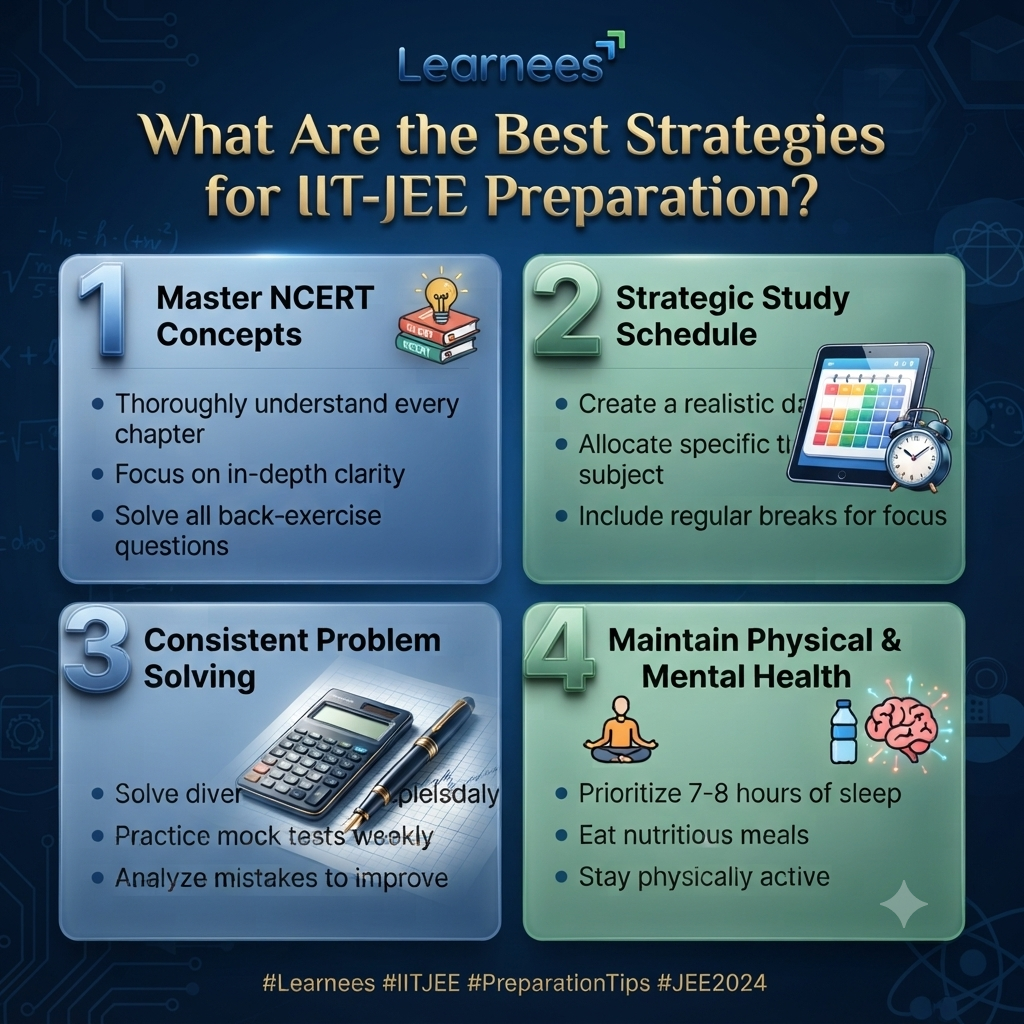
Preparing for the IIT-JEE exam requires more than simply studying for long hours. Students need a clear strategy, consistent practice, strong conceptual understanding, and regular revision. Whether you are starting your preparation in Class 11, preparing alongside Class 12 board exams, or taking a drop year, having a structured approach can make your preparation more manageable. The Joint Entrance Examination (JEE) is conducted in two stages: JEE Main and JEE Advanced. Both require students to build a strong foundation in Physics, Chemistry, and Mathematics while developing problem-solving and time-management skills.
In this guide, we will discuss some of the most practical IIT-JEE preparation strategies that students can follow to make their preparation more organized and effective.
Table of Contents
- Understand the JEE Main and JEE Advanced Pattern
- Start With the NCERT Fundamentals
- Build Strong Concepts
- Create a Realistic Study Timetable
- Prioritize Important Topics
- Practice JEE-Level Questions Regularly
- Use Previous Year Questions
- Take Mock Tests and Analyze Mistakes
- Revise Consistently
- Balance Board Exams and JEE Preparation
- Choose Study Resources Carefully
- Take Care of Your Routine and Well-Being
- Common Mistakes to Avoid
- Frequently Asked Questions
- Final Thoughts
1. Understand the JEE Main and JEE Advanced Pattern
Before beginning serious preparation, students should understand what they are preparing for.
JEE Main and JEE Advanced have different examination structures and requirements. Students should regularly check the official NTA and JEE Advanced information for the latest syllabus, examination pattern, eligibility requirements, and instructions because these details can change.
Understanding the exam helps students answer important questions such as:
- Which subjects need more attention?
- What type of questions are asked?
- How much time should be spent on each section?
- Which topics are included in the current syllabus?
- How should preparation be divided between JEE Main and JEE Advanced?
A clear understanding of the examination should be the starting point of your preparation.
2. Start With the NCERT Fundamentals
NCERT textbooks are particularly important for building fundamental understanding, especially in Chemistry.
Students should avoid immediately jumping into very difficult reference books without understanding the basics. First, make sure you are comfortable with:
- Basic formulas
- Definitions
- Fundamental concepts
- Important reactions in Chemistry
- Mathematical principles
- Basic Physics concepts
Once your fundamentals are clear, you can gradually move toward more challenging JEE-level problems.
3. Build Strong Concepts
One of the most important IIT-JEE preparation strategies is conceptual clarity.
JEE preparation is not simply about memorizing formulas. Students should understand why a formula works and where it can be applied.
For example, while studying Physics, don’t only memorize equations. Understand:
- What each variable represents
- The conditions under which the formula applies
- How different concepts are connected
- How the concept can be used in numerical problems
The same approach should be followed in Mathematics and Chemistry.
If a concept is unclear, resolve the doubt before moving too far ahead. Small gaps in understanding can become bigger problems when you reach advanced topics.
4. Create a Realistic Study Timetable
A good timetable should be realistic rather than extremely demanding.
Instead of creating a schedule that requires studying continuously for many hours, divide your preparation into manageable sessions.
A simple daily structure could include:
| Activity | Purpose |
| Concept Study | Learn or understand a topic |
| Problem Solving | Apply the concept |
| Revision | Strengthen previously studied topics |
| PYQs | Understand actual exam-level questions |
| Doubt Solving | Clear difficult concepts |
| Short Breaks | Maintain concentration |
Your timetable should also leave enough time for sleep, meals, school, and other necessary activities.
Consistency over several months is generally more useful than following an unrealistic schedule for a few days.
5. Prioritize Important Topics
The JEE syllabus is extensive, so students should plan their preparation carefully.
Start by dividing the syllabus into:
- Strong topics
- Average topics
- Weak topics
- Topics that have not been studied yet
Then create a study plan around these categories.
You should not completely ignore difficult chapters, but spending all your preparation time on one difficult topic can also affect overall progress.
A balanced strategy is to strengthen your strong areas while gradually improving weaker topics.
6. Practice JEE-Level Questions Regularly
Understanding a concept is only the first step. You also need to know how to apply it.
After completing a chapter, solve different types of questions.
Start with basic problems and gradually move toward more challenging questions.
During practice, ask yourself:
- Did I understand the question correctly?
- Which concept should I use?
- Did I choose the correct formula?
- Where did I make the mistake?
- Could the problem be solved using another approach?
This type of analysis helps develop problem-solving ability instead of encouraging random formula memorization.
7. Use Previous Year Questions
JEE Previous Year Questions (PYQs) are one of the most useful resources for understanding the actual examination.
Solving PYQs can help students become familiar with:
- Question patterns
- Difficulty levels
- Frequently tested concepts
- Application-based problems
- Time management
Don’t simply solve PYQs and check the answers.
Maintain a record of questions you could not solve or questions where you made mistakes. Revisit these questions during revision.
For more preparation guidance, students can also explore educational resources and test series available through Learnees, where students can discover and compare different learning opportunities.
8. Take Mock Tests and Analyze Your Mistakes
Mock tests can help students understand how they perform under examination conditions.
However, simply taking tests is not enough.
The most valuable part of a mock test is often the analysis after the test.
After completing a test, categorize your mistakes:
Conceptual Mistakes
You didn’t understand the concept correctly.
Calculation Mistakes
You understood the question but made an arithmetic or calculation error.
Time-Management Mistakes
You spent too much time on particular questions.
Question-Selection Mistakes
You attempted a question that could have been skipped or left for later.
Keeping a mistake notebook can make revision more targeted.
9. Revise Consistently
Students often spend a lot of time learning new chapters but don’t revise older ones.
This can lead to forgetting previously studied concepts.
Create a revision cycle. For example:
Learn → Practice → Revise → Test → Analyze → Revise Again
During revision, focus on:
- Important formulas
- Short notes
- Difficult concepts
- Mistake questions
- Previous year questions
- Frequently forgotten topics
Revision should become a regular part of your timetable rather than something you do only before an examination.
10. Balance Board Exams and JEE Preparation
Class 12 students often need to prepare for both board examinations and JEE.
Fortunately, there is considerable overlap in the fundamental concepts of Physics, Chemistry, and Mathematics.
A practical approach is to study the concepts thoroughly for school and then practice additional JEE-level questions.
During board-exam periods, your schedule may need to temporarily give more attention to board subjects. After the board examinations, you can adjust the schedule according to your JEE requirements.
The key is to avoid treating board preparation and JEE preparation as completely separate activities.
11. Choose Study Resources Carefully
There are countless books, videos, test series, websites, apps, and courses available for JEE preparation.
Using too many resources can sometimes create confusion.
Instead, choose resources based on your learning requirements.
Before selecting a course or test series, consider:
- Course syllabus
- Teaching format
- Faculty information
- Number and quality of practice questions
- Test frequency
- Doubt-solving support
- Course duration
- Fees
- Online or offline format
- Reviews and student feedback
Students and parents can use education marketplaces such as Learnees to explore available courses and educational providers and compare options based on their requirements.
The goal is not to collect the maximum number of resources. The goal is to use a manageable set of reliable resources consistently.
12. Take Care of Your Routine and Well-Being
JEE preparation is a long-term process.
Students should maintain a healthy daily routine that includes adequate sleep, regular meals, short breaks, and some physical activity.
Avoid measuring your preparation only by the number of hours spent studying.
For example, four focused hours of study with proper problem-solving may be more productive than many unfocused hours.
A sustainable routine can help you maintain consistency over a longer preparation period.
13. Common Mistakes to Avoid
While preparing for JEE, students should watch out for some common mistakes.
Studying Without a Plan
Jumping randomly between chapters can make preparation difficult to track.
Ignoring Weak Topics
Avoiding difficult chapters completely can create gaps in your preparation.
Collecting Too Many Books
More resources do not automatically mean better preparation.
Not Solving Questions
Reading theory without sufficient problem-solving practice can limit your ability to apply concepts.
Ignoring Mistakes
If you repeatedly make the same mistake but don’t analyze it, the problem may continue.
Avoiding Mock Tests
Waiting until the final stage to start testing yourself can make time management more difficult.
Comparing Your Preparation With Others
Every student has a different starting point, learning speed, and schedule. Focus on your own progress.
Frequently Asked Questions
1. What is the best strategy for IIT-JEE preparation?
A practical strategy combines conceptual learning, regular problem-solving, previous year questions, revision, mock tests, and mistake analysis. Consistency is important throughout the preparation period.
2. When should students start preparing for JEE?
Many students begin structured JEE preparation in Class 11, while others start earlier or later. The appropriate starting point depends on the student’s academic foundation, goals, and available preparation time.
3. Are NCERT books enough for JEE preparation?
NCERT books are important for building fundamentals, particularly in Chemistry, but JEE preparation generally requires additional practice with JEE-level problems and previous year questions.
4. How important are JEE Previous Year Questions?
PYQs are useful for understanding the types of questions asked, identifying important concepts, and practicing examination-style problems.
5. How often should JEE aspirants take mock tests?
The frequency can vary depending on the stage of preparation. Students can gradually increase full-length tests as they become more comfortable with the syllabus and examination pattern.
6. Should students prepare for JEE and board exams together?
Yes. Students can integrate board and JEE preparation because many fundamental concepts overlap. However, the study schedule may need to change during the board-examination period.
7. Is coaching necessary for JEE preparation?
Not every student follows the same preparation method. Some students use classroom coaching, some prefer online courses, and others combine self-study with test series and selected learning resources. The right choice depends on individual learning needs, budget, schedule, and preferred learning style.
Conclusion
There is no single IIT-JEE preparation strategy that works exactly the same way for every student.
A strong preparation plan should include clear concepts, regular practice, PYQs, revision, mock tests, and continuous mistake analysis. Students should also review their progress regularly and adjust their timetable when necessary. If you are looking for coaching institutes, courses, or test series, Learnees – An Education Marketplace can help students and parents discover, explore, compare, and connect with different educational providers based on their requirements. The objective should be to build a preparation system that you can follow consistently rather than searching for a shortcut.
Contact us now : + 91 9278097629